
A personal return to composition, intention, and muscle memory 🎛️🧠
This review exists for a very specific reason. I spent my own money on both the Polyend Tracker+ and the Akai MPC Live 3 with a deliberate goal: to get back into music composition as a practice, not music production as a productivity exercise. After years of DAWs, infinite plugins, and visual timelines that encourage tinkering over finishing, I wanted hardware that would slow me down in the right places and speed me up where it mattered.
What I didn’t expect was how deeply personal the experience would become.
I didn’t grow up with Ableton or Logic. I grew up painstakingly sequencing on a Brother PDC-100, which is still one of the strangest but most formative tools in my musical life. Brother, better known for printers and sewing machines, somehow produced a hardware MIDI sequencer that forced discipline into every decision. The interface was sparse, the LCD tiny, and the workflow unforgiving. But it taught me how to think in steps, measures, events, and intention rather than gestures and vibes. More on the Brother PDC-100 @ SonicState: https://sonicstate.com/synth_reviews/brother_pdc100pro/
That sequencer drove my first serious rig. An Ensoniq ASR-10 sat at the center as sampler, sound shaper, and creative anchor. A Korg 01/W handled pads and evolving digital textures, and an Alesis SR-16 provided drums with mechanical reliability. There were no waveforms to stare at, no undo stack you trusted, no piano roll safety net. If something felt wrong, you hunted it down event by event. That experience permanently shaped how I hear rhythm, structure, and timing.
Decades later, powering on the Polyend Tracker+ didn’t feel retro. It felt familiar.
Workflow and UI/UX
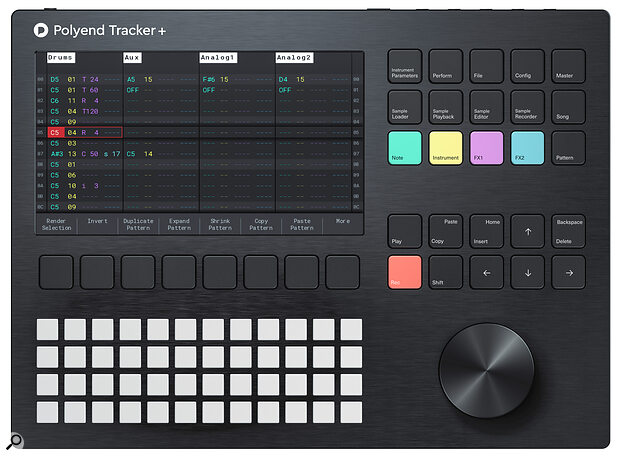
The Tracker+ does not try to be friendly in the modern sense. It doesn’t flatter you with immediacy or reward impulsive looping. Instead, it asks you to commit. Notes scroll vertically like a spreadsheet, and every step can contain pitch, velocity, micro-timing, probability, rolls, retriggers, and effect commands. Music here is authored, not performed. You build it deliberately, line by line, decision by decision.
At first, the interface can feel intimidating, even cold. But once the logic clicks, the workflow becomes deeply meditative. Shortcuts are thoughtfully designed, the encoder has physical resistance that encourages precision, and the system rewards patience with nuance. I find myself thinking more about arrangement, harmony, and negative space. I make fewer impulsive edits and more intentional ones. Most importantly, I finish ideas more often.
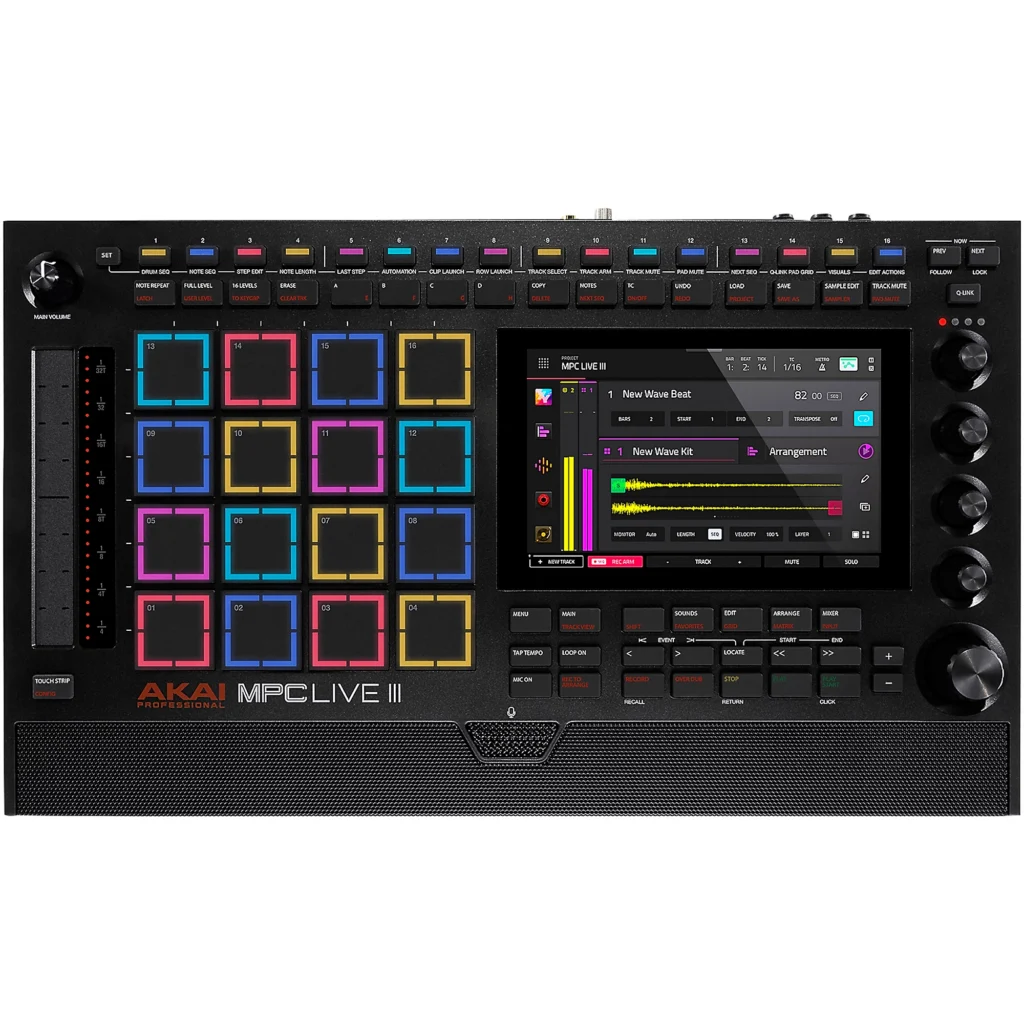
The Akai MPC Live 3 sits at the opposite end of the creative spectrum. It is immediate, expressive, and welcoming. Pads invite performance, the touchscreen encourages exploration, and clip launching opens non-linear workflows that feel alive and kinetic. You can sketch an idea in seconds, layer sounds quickly, and move fluidly between sequencing and performance.
Akai’s UI feels mature in the best way. Years of iteration show. The MPC Live 3 excels at capturing ideas before they disappear and shaping them through touch, rhythm, and motion. Where the Tracker+ pulls you inward and slows your thinking, the MPC Live 3 pushes you outward and keeps momentum high. Neither approach is better. They are complementary.
Hardware specifications and flexibility
On paper, the MPC Live 3 is unquestionably the more powerful machine. A modern multi-core processor, generous RAM, massive internal storage, expressive 3D pads, CV/Gate outputs, USB-C audio streaming, internal speakers and microphone, and a deep plugin ecosystem make it capable of replacing a DAW for many workflows. It scales effortlessly from couch sketching to being the centerpiece of a complex studio.
The Tracker+ is deceptively powerful but intentionally constrained. Sixteen tracks, stereo sampling, granular and wavetable engines, five internal synth types, FM radio sampling, USB audio with multi-track export, and microSD storage all live inside a compact, solid enclosure. The limitations are not accidents. They are design decisions. Not every track can do everything, and that friction forces better compositional choices.

The difference is philosophical. The MPC Live 3 asks, “What do you want to do next?” The Tracker+ asks, “What actually needs to happen here?”
Sound quality
Both devices operate at 44.1kHz, but they sound and feel very different in practice. The Tracker+ leans toward character. Mono or stereo sampling, bit reduction, granular manipulation, and slightly rough-edged synth engines encourage texture and contrast. I often find myself deliberately choosing imperfection, embracing grit, and letting artifacts become part of the composition.
The MPC Live 3 sounds modern and polished. Effects are studio-grade, plugins are clean, and layered arrangements retain clarity even as complexity grows. It excels at contemporary production aesthetics and dense sound design. Where the Tracker+ invites you to sculpt sound like clay, the MPC Live 3 gives you a finished toolkit ready for release-quality output.
Precision and resolution of MIDI control
This is where the Tracker+ quietly asserts dominance. Per-step micro-timing, probability, and event-level control make MIDI feel surgical. Groove lives inside the sequence rather than being layered on top through swing settings or automation lanes. You can create rhythms that breathe and evolve without ever leaving the core sequencing view.
The MPC Live 3 offers expressive MIDI control and excellent performance-oriented sequencing, but precision often lives behind menus and automation lanes. It’s powerful, but it’s optimized for gesture rather than microscopic control. The Tracker+ feels closer to algorithmic composition, while the MPC feels closer to live musicianship.
Inputs and outputs
Connectivity reflects each machine’s intent. The Tracker+ offers stereo line in and out, headphone out, mic in, MIDI via adapters, and USB-C audio with multi-track export. It’s compact but surprisingly capable, especially when paired with a DAW for finishing work.
The MPC Live 3 is unapologetically expansive. XLR combo inputs, multiple outputs, CV/Gate, USB host and device modes, SD storage, internal mic, and speakers allow it to anchor an entire hardware ecosystem without compromise. If connectivity matters most, the MPC Live 3 is in a different league.
Final thoughts 🎼
I didn’t buy these machines to replace each other. I bought them to balance each other. The MPC Live 3 reconnects me to playing, performing, and moving fast. The Polyend Tracker+ reconnects me to thinking, shaping, and composing with intent.
The reason the Tracker+ hit so deeply is simple. It speaks the same language as that old Brother PDC-100: discipline, limitation, and control, just without the pain. It didn’t feel like nostalgia. It felt like muscle memory.
If you’re returning to music after time away, the question isn’t which machine is better. The question is whether you want to play again or think again. The real answer, if you’re lucky, is that you get to do both.
Breakdown ratings ⭐
Polyend Tracker+
Workflow & UI/UX: ★★★★☆
Hardware specifications & flexibility: ★★★★☆
Sound quality & character: ★★★★☆
MIDI precision & resolution: ★★★★★
Inputs & outputs: ★★★★☆
Overall rating: ★★★★☆ (4.3/5)
Akai MPC Live 3 (we’ll do a follow up review)
Workflow & UI/UX: ★★★★★
Hardware specifications & flexibility: ★★★★★
Sound quality & polish: ★★★★★
MIDI precision & performance: ★★★★☆
Inputs & outputs: ★★★★★
Overall rating: ★★★★★ (4.8/5)
Leave a Reply