
I had been using an AKG pair of headphones for my home studio, they were fantastic and lasted, gosh, nearly 10 years. As I was looking for comparable models, I was a bit disappointed in the available options so I decided to swap to Sennheiser.
Like everything I review, I bought these myself so you don’t have to. Most headphones flatter you. They pump the low end, sweeten the top, and send you off believing your track sounds better than it does. The Sennheiser HD 400 Pro does not do that. What I get from it is an honest audio representation of tracks and music, and that is both the whole pitch and the whole reason to own a pair. If a mix is muddy, it sounds muddy. If a vocal is harsh, you hear the harshness. That is not always pleasant, and it is exactly the point.
This is a long review, because a studio headphone is a long decision. You will wear it for thousands of hours, and every mix you make will pass through it on the way to everyone else’s speakers. So I am going to cover where this headphone comes from, what you get in the box, how it is built, how it feels at hour ten, what the spec sheet really says, how it sounds range by range, how it behaves as a mixing tool, what to plug it into, what else you could buy instead, and whether the price makes sense. If you only want the answer, skip to the verdict. If you are about to spend your own money, stay with me.
Leaving AKG after ten years
Ten years is a long run for anything you wear on your head for a living. My AKGs earned that loyalty the honest way: they sounded right, they survived daily use, and they never gave me a reason to shop. When they finally reached the end, my plan was simple. Buy the modern equivalent and get back to work.
That plan fell apart quickly. The AKG I went looking for is not quite the AKG I bought into a decade ago. The company was founded in Vienna in 1947 and spent most of a century building studio staples there. Harman bought it in the 1990s, Samsung bought Harman in 2017, and the Vienna operation was closed that same year. A group of former AKG engineers stayed in the city and started their own company, Austrian Audio, which tells you something about where the institutional knowledge went. The badge is still on the shelf, and some of the classic models are still in the catalog, but as I looked at comparable models I was a bit disappointed in the available options. Nothing made the case that it was the natural successor to what I had.
So I did what I suspect a lot of long-time AKG owners end up doing. I looked across the aisle at the other great European headphone house. Sennheiser has been making open-back headphones longer than anyone, it has a current model aimed squarely at people who mix, and the price was well inside what I was prepared to spend on something I use every day. I bought the HD 400 Pro with my own money, put it on, and started working. What follows is what I found.
Where it comes from
Sennheiser started in 1945, when Fritz Sennheiser set up a small laboratory in a farmhouse outside Hanover. The company made its name on microphones, but the product that matters for this review arrived in 1968. The HD 414 was the first open-back headphone sold to the public, a light, airy design that let sound escape through the back of the cup. It sold in the millions and created the category this headphone belongs to.
The open-back line that followed is the closest thing headphones have to a royal family. The HD 580 arrived in the early 1990s, the HD 600 in 1997, and the HD 650 in 2003. The 600 and 650 are still in production and still treated as reference points by engineers and audiophiles decades later. That kind of shelf life is almost unheard of in consumer electronics, and it is a large part of why I trusted the brand enough to switch.
Here is the odd part. For all that open-back heritage, Sennheiser’s Pro line was closed-back territory: the HD 200 Pro, HD 280 Pro and HD 300 Pro. The HD 280 Pro in particular is in half the tracking rooms on earth. The famous open-backs were sold to listeners, not to studios, even though studios bought them anyway. The HD 400 Pro is the first open-back headphone to carry the Pro name.
There is a corporate reason for the timing. In 2021 Sennheiser agreed to sell its consumer headphone business to the Swiss hearing company Sonova, and the deal closed in 2022. Consumer models like the HD 600 and HD 560S now come from Sonova under the Sennheiser name. The family-owned Sennheiser that remains is a professional audio company, and a professional audio company needs its own open-back headphone in its own catalog. The HD 400 Pro, announced in late 2021, is that headphone.
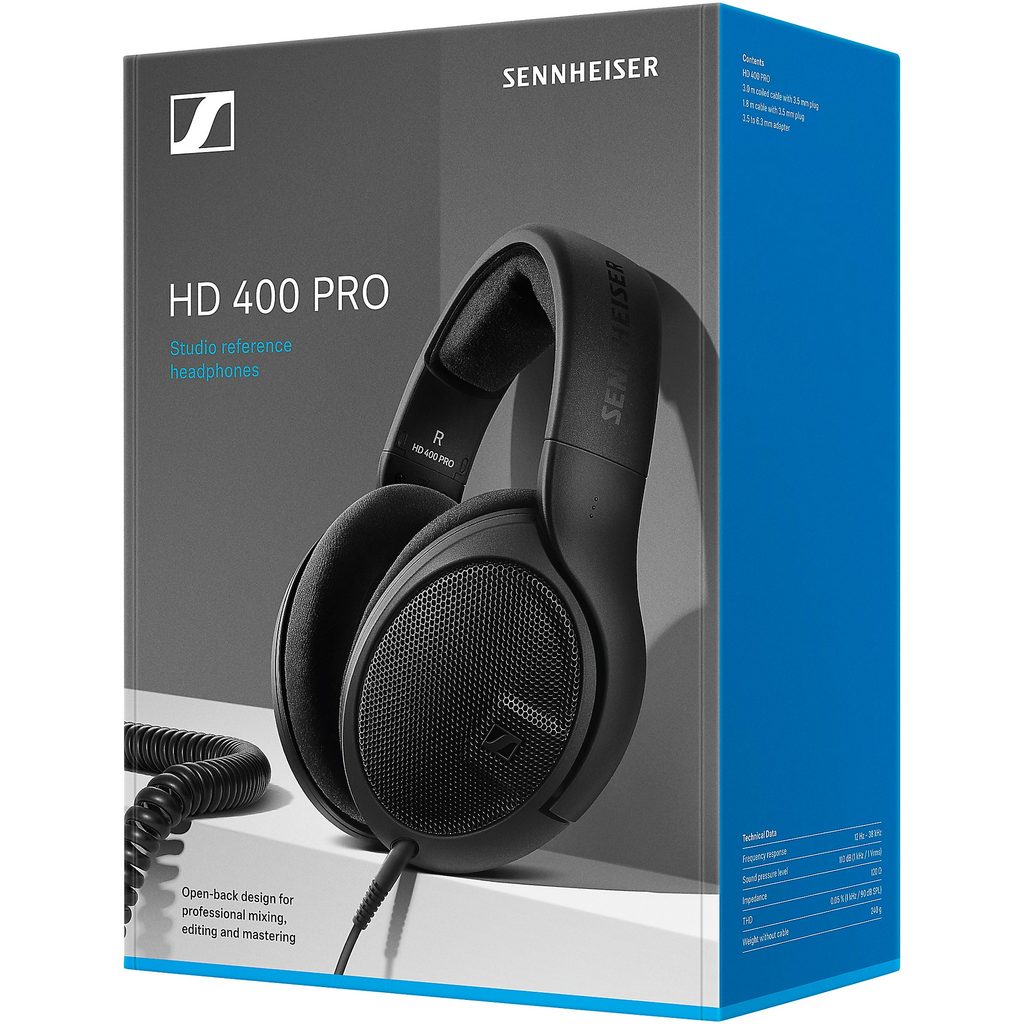
Which brings me to the thing Sennheiser does not put on the box. The HD 400 Pro is not quite a new headphone. Its closest relative is the consumer HD 560S from 2020, which shares the frame, the driver design, and very nearly the sound. Sennheiser took its most neutral consumer design, blacked out the logos, added a second cable, and moved it to the pro catalog. I do not say that as an insult. The 560S was already the most studio-minded headphone in the consumer range. But you should know it before you buy, and I’ll come back to what it means for your wallet.
Open-back, and why it matters
If you are coming from closed headphones, the first thing to understand is that open-back is not a feature. It is a trade.
A closed-back headphone seals the driver inside a solid cup. That keeps your music in and the room out, which is exactly what you want when a singer is standing in front of a live microphone. The cost is acoustic. Sound bounces around inside that sealed cup, the bass tends to swell, and the whole presentation sits tight against your skull.
An open-back headphone replaces the solid cup with a grille. The driver breathes. Reflections escape instead of piling up, the low end tightens, and the sound stops feeling like it is trapped between your ears. This is why mixing and mastering engineers reach for open-backs when they have to work on headphones. The presentation is closer to speakers in a room, and decisions made on them tend to travel better.
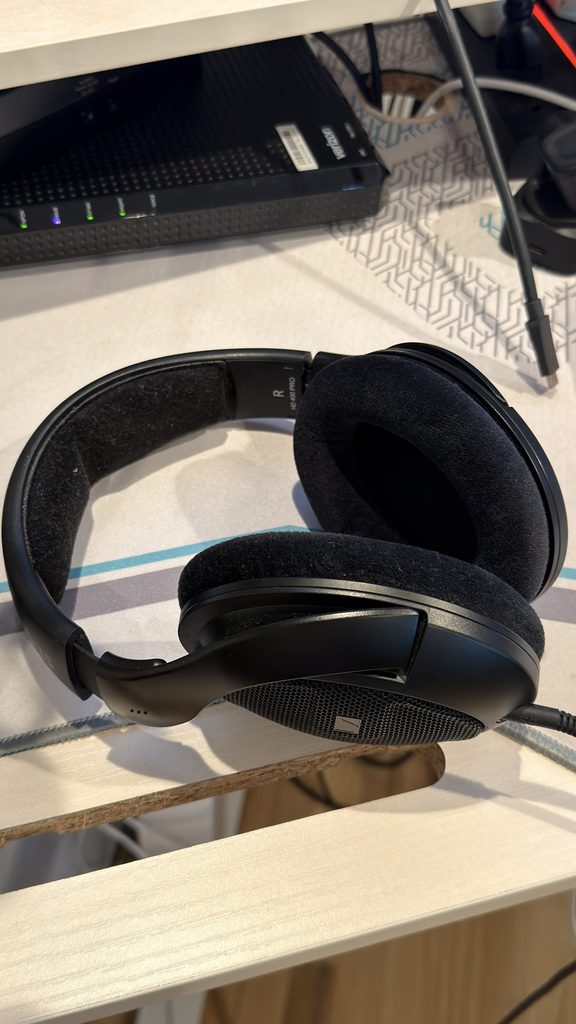
The bill for that comes due in two places. First, you hear everything around you: the computer fan, the air conditioning, the dog. Second, everyone around you hears everything you are playing. The HD 400 Pro leaks like a small speaker. You cannot track vocals with it, because the click and the backing track will bleed straight into the microphone. You cannot use it on a train or in an open office without becoming that person. And you should not judge fine detail on it in a noisy room, because the room will mask what the headphone is trying to show you.
So be honest about your space before you go any further. If you record in the same room you mix in, you need a closed pair for tracking as well as this. If you have a reasonably quiet room and you want to hear into a mix, keep reading.
What you get in the box
Not much, and that is a statement of fact, not a complaint about the price. The packaging is plain grey cardboard with a photo on the front. Inside, the headphones sit in a cardboard cradle. There is no foam, no molded tray, and no sense of occasion.
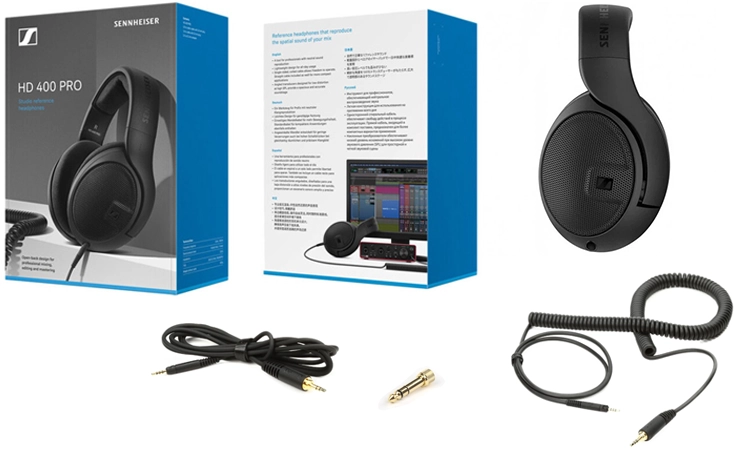
You get the headphones, two cables, a screw-on quarter-inch adapter, and some paperwork. One cable is coiled and stretches to about three meters. The other is straight and runs 1.8 meters. That second cable is the one real upgrade over the consumer sibling, which ships with a single long cable, and it changes how the headphone lives on a desk. The coiled cable is for the studio chair that rolls between a keyboard and a console. The straight one is for the laptop on the couch.
What you do not get is anywhere to put them. There is no case, no bag, not even a cloth pouch. For a product with Pro in the name, sold to people who carry gear between rooms and sessions, that is a miss. Budget for a hard case if these are ever leaving the desk. There are no spare earpads either, though replacements are easy to find.
Build and design
Everything except the grille is plastic. The headband, the yokes, the cups, the sliders: all of it. If you are used to the metal hardware on older studio headphones, your first impression in the hand will be that this is a lighter, plainer object than the price suggests.
Live with it for a while and that impression changes. The unit is relatively sturdy. The plastic is dense and matte, it does not creak when you flex the headband, and the sliders click into position and stay where you leave them. Sennheiser has been building headphones on this general frame for years, and plastic of this kind has a way of outlasting metal that bends and hinges that loosen. There is very little here that can go out of alignment, because there is very little here that moves.
That is also the limitation. The cups pivot only a few degrees, enough to settle against your head and no more. They do not rotate flat, so you cannot lay the headphones on your chest or slide them neatly into a bag. They do not fold. The shape you see is the shape you store.
Visually, this is the stealth version of the family design. Where the consumer model has silver logos, here everything is black on black: the grilles, the badges, the lettering on the headband. On a desk full of gear it disappears, which I count as a point in its favor. The pads and the headband cushion are velour over foam, and the pads pull off and snap back on without tools. That matters more than it sounds, because the pads are the part of any headphone that wears out first. They flatten after a couple of years of daily use, the seal and the distance to the driver change, and the sound changes with them. Being able to swap them in ten seconds is what makes a ten-year headphone possible.
The workflow is pretty straightforward. You get a 3 m coiled cable and a 1.8 m straight cable, and you plug in and work. My gripe is the termination: both cables end in a native 1/8 inch plug, with a screw-on quarter-inch adapter for studio gear. I’m not a fan. In a room where everything is quarter-inch, a pro headphone should be too, and an adapter is one more joint in the chain. To be fair, it would be hard to assess any sonic loss from it. The other irritations are smaller: the headphone does not fold, there is no case in the box, and the cable socket uses a proprietary lock, so the spare cable in your drawer will not fit.
Comfort over a long day
At 240 grams, this is a light headphone, and weight is the single biggest factor in whether you can wear something all day. For comparison, plenty of studio headphones land between 280 and 350 grams, and you feel every one of those grams on the crown of your head by mid-afternoon.
The pads are large ovals that sit around the ear, not on it, and the velour breathes in a way that leather and vinyl do not. The clamp is a little firm out of the box and eases as the headband breaks in. The result is a headphone that is generally comfortable.
I say generally with intent. On my 12-hour mixing days, I have to give them a break a few times throughout. The clamp never becomes painful, and the velour never gets swampy, but there is a point where my head simply wants nothing on it for ten minutes. I do not hold that against the HD 400 Pro specifically. Your ears need those breaks anyway, because hearing fatigue sets in long before discomfort does, and a mix decision made at hour nine without a rest is rarely one you keep. Treat the comfort ceiling as a built-in reminder to step away.
If your sessions run two to four hours, you will not think about comfort at all. If they run all day, plan your breaks and you will be fine.
The spec sheet, decoded
Spec sheets are written to impress, so here is what the numbers on this one mean in practice.
The drivers are 40 mm dynamic units, and they are mounted at an angle inside the cup. Angling the driver fires the sound at your ear from slightly in front, closer to how sound from a speaker arrives. It is a small trick that helps the image sit forward instead of dead center in your skull.
The impedance is 120 ohms. That is higher than a typical consumer headphone and much lower than the 300 ohms of the HD 600 family. In practice it is a sensible middle. It is high enough to behave well on professional outputs, which are designed for loads like this, and low enough that a decent laptop can still drive it to working volume.
Sennheiser rates the output at 110 dB for one volt of signal. One volt is roughly what a modest headphone jack can deliver, and 110 dB is far louder than anyone should monitor. Translation: almost anything can make these loud. Loud is not the same as controlled, and I will get to that in the section on what to plug them into.
The frequency response is quoted as 6 Hz to 38 kHz. Read the fine print, because that range is measured at minus 10 dB, a generous tolerance. Nobody hears 6 Hz or 38 kHz, and this headphone does not reproduce them at full level. The figure tells you the response extends comfortably beyond both ends of human hearing, and nothing more.
Total harmonic distortion is quoted at under 0.05 percent at 1 kHz and 90 dB. That is a low number, and it lines up with what I hear. The clarity I describe below is partly a tuning choice and partly the simple absence of grit.
The sound
Two things define the sound: clarity and aperture.
The sonic clarity is the first thing you notice. There is no haze between you and the recording, no warm blanket laid over the mix to make it friendlier. Notes start cleanly and stop cleanly. Reverb tails are easy to follow all the way down into silence. Edits, clicks, and the breath before a vocal line are all just there, whether you wanted to hear them or not.
Behind that clarity is what I think of as a wide aperture in terms of the audible elements in a recording. Think of a camera lens opening up to let in more of the scene. Parts that sit buried on other headphones, a doubled guitar tucked under the lead, a shaker in the right channel, a pad that only swells in the chorus, are present and separate, each in its own space. You do not have to hunt for them. For mixing, this is the quality that matters most, because you cannot balance what you cannot hear.
The flip side of all that clarity is that a poorly recorded track shows its faults. Thin vocals sound thin. Over-compressed masters sound flat and tiring. Low-bitrate streams sound like what they are. If your listening diet is mostly modern, well-engineered material, this is a pleasure. If you love a lot of rough recordings for the songs and not the sonics, be warned that this headphone will not romanticize them.
The bass is precise and has body without bloom. Open-backs have a reputation for thin low end, and this one does better than that reputation: it reaches lower than you expect and stays even on the way down. Kick drums have a defined front edge. Bass lines stay readable as notes instead of blurring into a general warmth, and the kick and the bass occupy separate space, which is the single hardest thing to judge on headphones. What you will not get is physical impact. Nothing here moves air against your ears the way a closed-back or a subwoofer does. The low end is information, not sensation.
The midrange is where this headphone earns its keep. It is clean and uncolored, with natural instruments and vocals and nothing added for effect. Voices sit at a believable size, neither pushed in your face nor recessed behind the band. Guitars, pianos, and snares keep the character that tells you which instrument, which room, which player. Since the midrange is where most of the music lives and where most mix problems hide, getting it this right covers a lot of ground.
The highs are the weak spot. They do saturate, especially on hi-hats and other high treble instruments. Cymbals, shakers, tambourines, the top edge of an acoustic guitar: when the arrangement gets busy up there, the top end fills up and crowds together before the recording itself does.
It is the one place where the honesty slips. Everywhere else, this headphone reports what is on the track. In the top octaves it adds a little pressure of its own, and you have to learn to hear through it. On sparse material you will not notice. On a dense rock or electronic mix with a lot of cymbal work, you will.
This matters for mixing in a specific way. If the headphone overstates the hats, your instinct will be to pull them down, and then the mix sounds dull everywhere else. Know that going in, and check your cymbals and hats on a second reference before you start reaching for the fader. Once you have learned the offset, you can work with it. It also has one side benefit: sibilance and harsh top end in a vocal are impossible to miss.
For pure listening, the same trait is a matter of taste and stamina. Over a short session it reads as sparkle and air. Over a long one, on bright material, it is the thing most likely to make you take the headphones off.
The stage is moderately wide with real depth, and the stereo field is drawn sharply enough to place sounds precisely in a dense mix. Pan a part thirty degrees left and it sits thirty degrees left, not somewhere in a vague cloud on that side. Depth cues, the sense that one sound is behind another, come through clearly, which helps when you are setting reverb and delay levels.
Keep your expectations calibrated, though. It will not fool you into thinking you are in front of speakers. The image still forms inside and around your head, as it does on every headphone at this level. And it is not an HD 800, Sennheiser’s famously vast flagship, but nothing near this price should be.
Mixing on them
A headphone review that stops at how music sounds misses the point of a product like this. The question is whether work done on it holds up everywhere else.
The case for the HD 400 Pro as a mixing tool rests on the two strengths above. The clarity lets you hear small moves: half a decibel on a vocal, a slightly shorter reverb, a compressor grabbing a little too hard. The aperture lets you hear every element at once, so you can balance the whole arrangement instead of soloing your way through it. And the even low end means you can make sensible decisions about the kick and bass relationship without guessing, which is where most headphone mixes go wrong.
The case against is the one I have already made. The highs saturate, so top-end balance needs a second opinion. And like any headphone, it gives you a hard left and right that speakers do not, so wide-panned parts can seem more separate than they will in a room.
The working method that follows from that is simple. Use reference tracks, commercial mixes you know well, and flip to them often so your ears stay anchored to how finished records sound on this headphone. Monitor at a moderate level, because the clarity makes it tempting to creep the volume up, and loud monitoring flatters everything. Check the low end and the cymbals on whatever else you have: monitors, a car, earbuds, a phone speaker. And take the breaks your head is asking for anyway.
Worked that way, the HD 400 Pro is a credible primary tool for a home studio and a strong second opinion for anyone with good monitors. It is also very good at the unglamorous hours that make up most of production: editing takes, auditioning sounds, cleaning up noise, lining up edits. Those jobs need clarity and comfort more than they need perfection, and this headphone has both.
What to plug them into
At 120 ohms, the HD 400 Pro wants a decent source, but it is not fussy. A laptop headphone jack will drive it to a healthy level. What you give up on a weak output is control: the bass loosens a little and the stage narrows. It only opens up fully from a proper headphone output.
The good news is that a proper headphone output is something you probably already own. Any modern audio interface has one, and that is all this headphone needs. If your interface gets it comfortably loud with the knob around the middle of its travel, you are done. A dedicated headphone amplifier is a nice thing to have and not a requirement, and I would not let anyone talk you into spending as much on an amp as on the headphone.
One practical note on the plug. Because the cables end in a small 1/8 inch connector, the quarter-inch adapter will be living on the end of yours permanently if you work at an interface. It screws on, so it will not pull off and vanish into a cable drawer. Being open-back, the headphone isolates almost nothing and leaks plenty, so wherever you plug in, plug in somewhere quiet.
Against the alternatives
No headphone is bought in a vacuum, so here is the map of what else your money could do. This section is about positioning: what each option is, what it costs, and who it suits.
Start with the sibling, because it is the comparison that matters most. The Sennheiser HD 560S is the consumer headphone the HD 400 Pro is built from. Same frame, same driver design, same 120 ohm impedance, same 240 grams, and a sound close enough that most people would struggle to tell them apart without switching back and forth. The differences are practical. The 560S comes with one long cable ending in a quarter-inch plug and a short adapter for small jacks. The 400 Pro comes with two cables ending in small plugs and an adapter for quarter-inch. The 560S has silver logos. The 400 Pro is all black. The 560S usually costs less. If you already own a 560S, there is no reason to buy this. If you are choosing between them new, the choice comes down to cables and price on the day.
One step up inside the same house is the HD 490 Pro, Sennheiser’s newer and more ambitious open-back for studios. It launched in 2024 at around $400, and it is a different design, not a rebadge. The headline feature is two sets of earpads with two tunings, one voiced warmer for long production sessions and one flatter for mixing. The cable can attach to either cup, and the fit is roomier. If you mix for a living and the budget stretches, it is the more complete tool. Whether it is worth roughly half as much again depends on how much of your income passes through your headphones.
Then there are the elders, the HD 600 and HD 650. These are the headphones that built Sennheiser’s reputation with engineers, and they remain the standard for a natural midrange. They are also a different proposition. At 300 ohms they need a real headphone amplifier to sound their best, they cost more, and their bass rolls away earlier at the bottom. The HD 400 Pro reaches deeper, is easier to drive, and presents a more modern, more open top end. The 600 and 650 are smoother and more forgiving up top. If the saturation I describe in the highs sounds like a dealbreaker, those are the two to audition.
The direct rival from outside the family is the Beyerdynamic DT 900 Pro X. It arrived the same year at a similar price, it is also an open-back aimed at mixing, and it is low impedance, so it runs from anything. Beyerdynamic builds it in Germany with more metal, a thicker headband, and a detachable cable on a standard locking connector, so on build quality it is the more reassuring object. It is also heavier by about a hundred grams, and Beyerdynamic’s house sound leans brighter. If you want a tank and like an energetic top end, look there. If you want the lightest thing you can mix on, stay here.
The Audio-Technica ATH-R70x deserves a mention because it is the featherweight of the class, lighter even than the Sennheiser, with a warmer and more relaxed tuning. It costs more and its 470 ohm impedance makes it the hardest of this group to drive well.
And for the AKG faithful, the old open and semi-open models are still out there, often for less than any of the above. They remain capable headphones. My own search through that catalog is how I ended up writing a Sennheiser review, so you know where I landed.
Who should buy it, and who should not
Buy the HD 400 Pro if you make music, podcasts, or video in a reasonably quiet room and you need a headphone that tells you the truth. It is the right first serious headphone for a home studio. It is a strong second reference for anyone who mixes on monitors and wants to check their work late at night without waking the house. It suits editors and sound designers who spend long hours on detail work. And it suits curious listeners who want to hear their favorite records the way the engineer did, flaws included.
Do not buy it if you need isolation. If you track vocals or acoustic instruments in the same room, if you work in a shared space, or if you commute, an open-back is the wrong design and no amount of sound quality fixes that. Do not buy it if you want big, physical bass for hip-hop or electronic music played loud. The low end here is accurate and it will feel polite. Do not buy it if you are sensitive to treble, because the highs are the one part of the tuning that pushes back. And do not buy it as an upgrade to an HD 560S, because it is not one.
If you fall between those two groups, the question to ask is simple. Do you want a headphone that makes music sound good, or one that tells you whether it is good? The HD 400 Pro is the second kind.
Price and value
I bought my unit for $250, which was also the launch price. It is now retailing for $279. That is the wrong direction for a headphone that has been on the market for years, and it matters, because the consumer HD 560S launched at $200 and is discounted often. The gap between the two was fifty dollars when I bought. Check it on the day you buy, because it may be wider now.
On performance per dollar it is hard to argue with. This is reference-grade clarity at a price that used to buy a competent tracking headphone and nothing more. It undercuts most open-back studio rivals, and on neutrality it runs close to headphones at twice the price. Add the low weight and the easy drive requirements, which save you the cost of an amplifier, and the total cost of getting good sound is lower than the sticker suggests.
Now the costs the sticker hides. There is no case, so add one if the headphones travel. The pads will need replacing every couple of years if you use them daily, which is true of every headphone but worth budgeting for. And the proprietary cable connector means replacements have to be the right part, not whatever is in the drawer. None of these is large. Together they are the difference between a product that feels generous and one that feels carefully costed, and this is the second kind.
The ownership math still works out well. If these last anything like the ten years my AKGs did, with a few sets of pads along the way, the cost per year of daily use is trivial next to almost anything else in a studio.
The friction is internal. If the 560S delivers nearly the same sound for less, the premium buys you a second cable and black paint. That is a fair trade if the coiled cable suits your room. It is a vanity tax if it doesn’t.
Making them last
I kept my last pair of studio headphones going for nearly ten years, and the habits that got them there apply here.
Hang them or lay them flat. Do not leave them clamped around a monitor or stretched over a rack case, because the headband takes a set and the clamp goes with it. Since there is no case in the box, a simple hook under the desk does more for longevity than anything else you can buy.
Mind the cable where it meets the cup. The connector twists and locks, so make sure it is seated fully before you start working, and never let the weight of the coiled cable hang off the edge of a desk and pull on it for hours. The cable is the part that fails first on most headphones, and the fact that this one detaches means a failure costs you a cable, not a headphone.
Keep the pads clean and replace them when they flatten. Velour collects dust and hair, and a lint roller once a month is all the maintenance it needs. When the pads no longer spring back, order a new set. You will hear the bass and the stage return on the first listen, and it is the cheapest upgrade this headphone will ever get.
Finally, protect the thing the headphones exist to serve. Clarity like this makes it easy to monitor louder than you mean to. Set a level you can hold a conversation over, and leave the volume knob alone.
Questions worth asking before you buy
Can you mix on these alone? You can get a mix most of the way there, and many people in small rooms get better results on a headphone like this than on monitors in an untreated space. Check the low end and the top end somewhere else before you call it finished.
Do you need an amplifier? No. An audio interface is enough. A laptop works in a pinch.
Can you record with them on? Only for instruments that go straight into the interface, like a keyboard or a bass through a direct box. Anything with an open microphone will pick up the leakage.
Are they good for casual listening, films, and games? Yes, if you like an honest presentation and you are alone in a quiet room. The precise imaging is a real asset for film and game audio. If you want a warm, bass-forward sound for relaxing, look elsewhere.
Is the second cable worth paying extra for? Only you can answer that, and the answer depends entirely on the price gap on the day you buy.
Verdict
I came to the HD 400 Pro as an AKG loyalist looking for a replacement, not a revelation. What I found is a headphone with a clear idea of its job. It is light, relatively sturdy, and generally comfortable. It gives me clear sonic clarity and a wide aperture into whatever I am working on. Its highs saturate on hi-hats and bright instruments, and I have learned to check around that. Its small plug and adapter still annoy me. It asks for a break a few times on a twelve-hour day, and so do I.
The HD 400 Pro is not a headphone for falling in love with your own music. It is a headphone for finding out the truth about it, in a light, sturdy-enough plastic shell, at a price that undercuts almost everything as honest. Buy it if you make things. Buy the 560S if you only listen, and it is cheaper that day.
I bought it and reviewed it so you didn’t have to!
Leave a Reply