
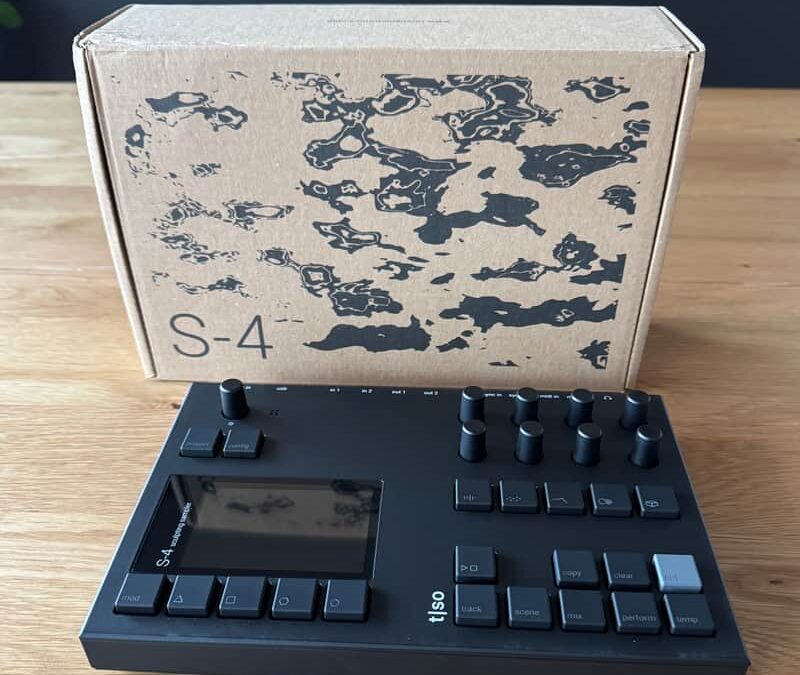
There is a specific kind of gear story we love around here: the box that launched too early, took a beating from the press, and then quietly became one of the best instruments in its category while nobody was looking. The Torso Electronics S4 is that story, and in 2026 it deserves a fresh look from anyone who wrote it off two years ago.
Torso Electronics is a small Danish company out of Copenhagen that made its name in 2020 with the T-1, an algorithmic sequencer with a cult following among hardware heads. The S4 is its second act: a “sculpting sampler” that is part four-track tape machine, part polyphonic sampler, part granular processor, and part multi-effects box, all wrapped in a slab of matte aluminum about the size of a hardcover book. It does not really have a direct competitor. That was true at launch, and it is still true now.
What It Actually Is
Strip away the marketing language and the S4 is four parallel stereo audio tracks, each running an identical five-stage signal chain:
Material is the front of the chain. Set it to Tape and the track behaves like a loop-based tape recorder: record, overdub, punch in, slow down, speed up. Set it to Poly and it becomes an 8-voice polyphonic sampler you can play over MIDI. Set it to Disc (added in OS 2.0) and it streams long-form audio, stems, or field recordings straight off internal storage with no practical length limit. Set it to Bypass and the whole track becomes a real-time effects processor for whatever you feed into the inputs.
Mosaic is the granular engine, and it is the heart of the instrument. It chops the incoming audio into up to 128 grains that can be pitched, panned, reversed, sprayed across the stereo field, and even quantized to a deep collection of scales. This is where drum loops turn into stuttering rhythmic clusters and a single sustained guitar note turns into a shimmering cloud.
Filter is not a normal filter. It is a 48-band resonant filter bank that can emulate classic filter shapes or morph between spectral states, which gets you into resonator and almost physical-modeling territory. Run a dry drum machine through it and sweep the morph control and you will understand why Torso called this thing a sculpting sampler.
Color handles the dirt: dual-band distortion, bit reduction, compression, and a noise generator, usable for anything from gentle tape-style warmth to total destruction.
Space closes the chain with stereo delay and reverb, multiple delay algorithms, and a freeze mode that is worth the admission price on its own for ambient players.
Every track also gets four assignable modulators (LFOs, envelopes, random sources, and, since OS 2.0, an envelope follower) that can be routed to essentially any parameter on the device. This is where the S4 stops feeling like a sampler and starts feeling like a modular system in a lunchbox: patch a random source to grain pitch, an envelope follower to filter morph, a slow LFO to tape speed, and walk away while the thing composes for you.
The Hardware
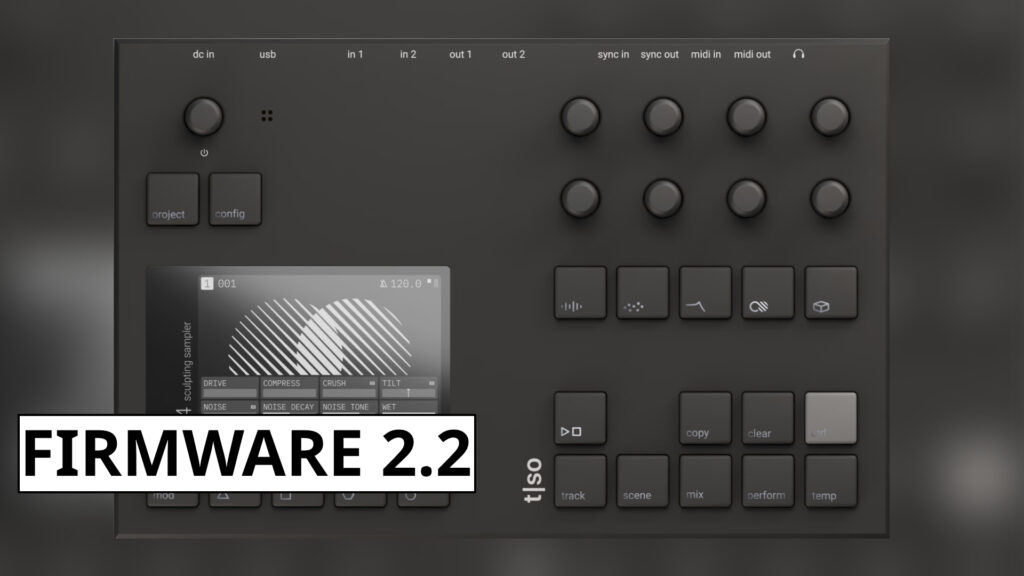
Physically, the S4 is lovely. The casing is matte black (or white, since the White Edition arrived in late 2025) aluminum, 242 x 156 x 39 mm and 820 grams, with a large, crisp color display, 21 clicky RGB backlit buttons, and 9 endless push encoders. Reviewers have consistently praised the build, and we agree: the encoders have proper resistance, the screen is genuinely informative rather than decorative, and the whole unit feels like it was designed by people who intend for you to perform on it, not just program it.
Connectivity is generous for the footprint: stereo line in and out on the back, a headphone out, full-size MIDI in and out, analog sync in and out for your modular or vintage gear, and USB-C. There is a built-in microphone for grabbing sounds on the fly, WiFi with Ableton Link support for wireless sync, and the USB port supports class-compliant audio interfaces if you need more I/O. Inside is a quad-core 1.5 GHz processor and 4 GB of flash storage for samples and projects.
One practical note: the S4 runs on a 12V supply and cannot be powered over USB, so this is a wall-wart instrument, not a battery-and-backpack one. It can, however, power a T-1 sequencer from its own USB port, which makes the two-box Torso ecosystem a tidy little live rig.
The Redemption Arc
Here is the part that history demands we cover. When the S4 shipped in 2023 at $899, the critical consensus was brutal in a very specific way: everyone loved the sound and nobody could recommend the purchase. MusicTech called it “beautiful but frustratingly incomplete,” noting that major features literally displayed “coming soon” messages on screen, and summed up the dilemma as paying $899 to be a beta tester. MusicRadar told readers to fall in love but wait for final firmware before spending. Sound On Sound called it “a work in progress” that “promises to be something very special indeed.” Early adopters on forums reported bugs, crashes, and a laborious sample-browsing experience with no audition function.
They were all correct. And then Torso did the thing small companies are supposed to do and so rarely actually do: it finished the instrument.
OS 2.0, released in June 2025, was not a patch. It was a complete rewrite of the core audio engine, and Torso described it, accurately, as finally fulfilling the original vision. It brought the Perform page (map any parameters across the whole machine to 8 macro sliders and 4 punch-in FX buttons), Scenes (128 full-state snapshots of parameters and samples, triggerable instantly or via MIDI Program Change), Temp (a brilliant performance feature that lets you twist a sound somewhere extreme and snap back to the saved state the moment you release), the Disc streaming device, varispeed recording, and the Follow envelope follower. CDM’s take on 2.0 was that it made the S4 “the performance sampler it wanted to be,” and that is exactly how it feels in use.
Then in June 2026, OS 2.2 rebuilt Mosaic, the granular engine, again. The buffer can now be locked and saved with a project, a new Scan control lets you freeze time and drift or scrub through the frozen buffer, new Warp spray modes handle real-time time-stretching, a proper Feedback parameter replaced the old sound-on-sound behavior, and grains can now be randomly pitched and randomly reversed with per-grain probability. Torso showed this off at Superbooth 2026 and it is, frankly, one of the deepest granular implementations in any standalone hardware right now.
All of these updates were free. Three years of continuous, substantial development on a device from a tiny company is not nothing, and it is the reason names like Surgeon and Nadia Struiwigh have been showing up with S4s in their live rigs.
In Use
The S4 rewards a particular kind of musician. If you think in songs, patterns, and arrangements, this is not your box: there is no sequencer onboard (Torso would politely point you at the T-1), no song mode, and no timeline. The S4 thinks in sound, not structure.
But if you think in texture, the workflow is close to frictionless. Hit record on a tape track, hum into the built-in mic or feed it a synth, and within seconds you are pulling that recording apart with grains, resonating it through the filter bank, and freezing the tail into an infinite pad. The four-track division of labor is entirely up to you: one track mangling a live input in Bypass, one playing chords as an 8-voice sampler, two running as tape loops underneath. Whole ambient sets live inside this box comfortably.
The Perform and Scene system elevates it from studio toy to legitimate stage instrument. Building a set as 20 or 30 scenes and riding the macros between them is immediate in a way very few samplers manage, and the Temp function encourages the kind of risk-taking that makes live electronic sets actually worth watching.
As a pure effects unit, it might be the sleeper application. Running external gear through Bypass mode gives you granular processing, the 48-band morphing filter, compression, drive, bit crushing, delay, and reverb with four modulators stirring the pot. MusicTech’s reviewer called this his favorite use of the device even back in the rough launch era, and with the 2.2 granular engine it has only gotten stronger.
The Gripes
The price has not budged: $899 is real money, and now sits against a crowded field of grooveboxes that do more conventional things for less. The sample browser is better than it was but file management still feels utilitarian. There is no sequencer, no song mode, and no undo history deep enough to fully save you from yourself. A handful of forum users still find the overall tone polite rather than characterful, and if your taste runs to gritty 12-bit crunch boxes, the S4’s pristine, modern voice may read as clinical until you lean on the Color section. And it needs wall power, full stop.
None of these are dealbreakers for the target user. They are simply the outline of what the S4 is not, and Torso has been unusually honest about that outline.
Verdict
Two years ago the S4 was a gorgeous promise with an asterisk. In 2026, the asterisk is gone. This is now a mature, deep, and genuinely unique instrument: the best standalone granular processor you can buy, a superb four-track texture machine, and a live effects unit with few rivals, all in one enclosure that feels built for a decade of use. The $899 price still demands commitment, and composers who need sequencing and song structure should look elsewhere. But for ambient artists, experimental producers, live performers, and anyone who treats sound itself as the composition, the S4 has quietly become essential, and Torso’s track record of free, transformative updates makes it one of the safest bets in boutique hardware.
The bottom line: buy it for what it is today, and expect it to keep getting better. That is a sentence we could not write in 2024, and it is the whole review.
Specs at a Glance
- Type: 4-track stereo sculpting sampler, granular processor, and multi-effects unit
- Engine: 4 parallel stereo tracks, each with Material, Mosaic (granular), Filter (48-band morphing resonator), Color, and Space devices
- Sampler: 8-voice polyphonic mode with MIDI control; Disc streaming for unlimited-length playback
- Modulation: 4 assignable modulators per track (LFO, envelope, random, envelope follower)
- Performance: Perform page with 8 macros and 4 punch-in FX; 128 scenes with MIDI Program Change
- I/O: 2 line in, 2 line out, headphone out, built-in mic, MIDI in/out, analog sync in/out, USB-C (class-compliant audio), WiFi with Ableton Link
- Brains: Quad-core 1.5 GHz processor, 4 GB flash storage, color LCD, 21 RGB buttons, 9 endless encoders
- Physical: Aluminum casing, 242 x 156 x 39 mm, 820 g, 12V DC power (no USB power)
- Firmware: OS 2.2 (June 2026), free updates
- Price: $899, Black or White Edition
Pros
- Unmatched granular depth in standalone hardware after OS 2.2
- The 48-band morphing filter bank is a genuine signature sound
- Excellent build, screen, and encoders
- Perform, Scenes, and Temp make it a real stage instrument
- Doubles as a world-class external effects processor
- Three years of substantial free firmware updates and counting
Cons
- $899 is a serious ask
- No sequencer or song mode
- File management remains utilitarian
- Wall power only
- Clean modern voice may feel polite to lo-fi devotees
Reviewed on firmware OS 2.2.0. Sources consulted: Torso Electronics product pages and OS 2.0/2.2 release notes, Sound On Sound, MusicTech, MusicRadar, CDM, Synth Anatomy, Gearnews, and community reporting on Elektronauts.
Leave a Reply