
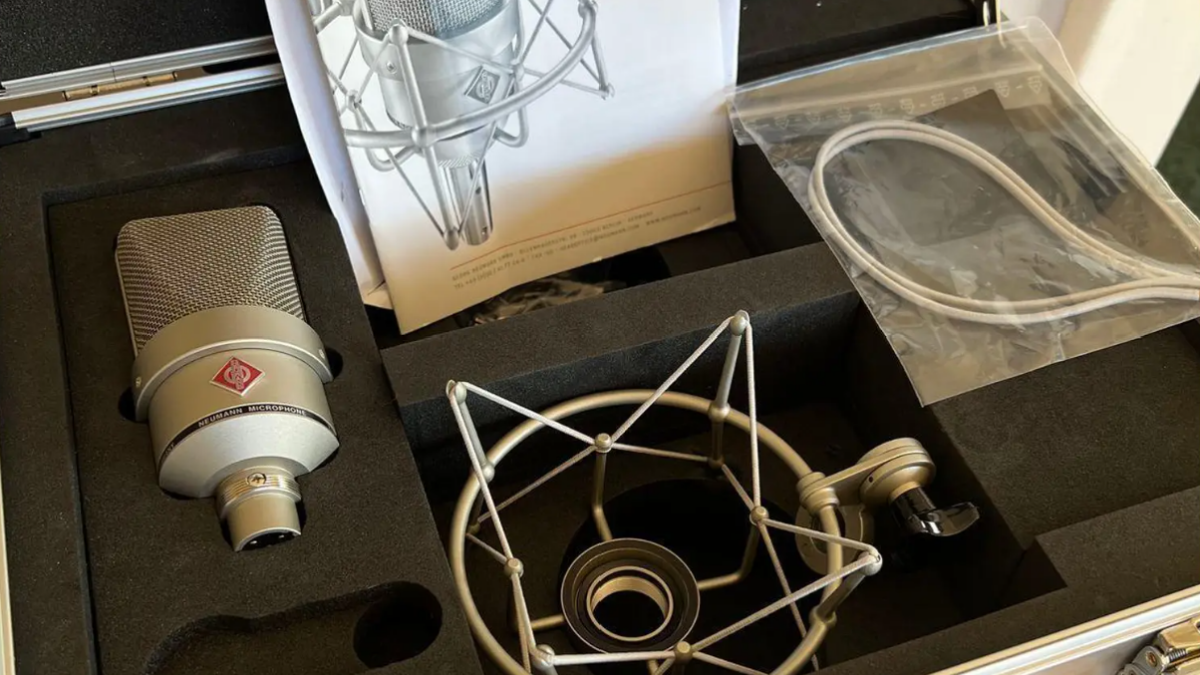
Every serious voice over shortlist of the last twenty five years ends the same way. Somewhere near the top sits the Neumann TLM 103, and next to it sits a price that makes you exhale slowly. I went in wanting to know one thing: is this microphone genuinely that good, or are we all paying rent on a badge? Rather than trust a single opinion, including my own bias toward anything wearing that diamond logo, I convened a roundtable. Bandrew Scott’s Podcastage bench test, Hugh Robjohns’ original Sound on Sound review from the mic’s launch, the capsule detectives at RecordingHacks, the buyer base at Sweetwater, and the perpetually unimpressed engineers of Gearspace all got a seat. What came back was more consistent than I expected, and more honest than the marketing.
History
Neumann has been the reference point for studio microphones since Berlin in 1928, and the U 87 has been the gold standard vocal condenser since 1967. The problem was always the invoice. A U 87 Ai runs around $3,700 today, which kept the brand out of reach for everyone below the big commercial rooms. In 1997 Neumann did something genuinely disruptive for a heritage brand: it shipped the TLM 103, a transformerless, fixed cardioid condenser built around a capsule descended from the U 87’s family, at a price under a thousand dollars. Radio stations noticed immediately. So did the voice over industry, which more or less adopted it as a house standard. Howard Stern put one in front of his face. Jack White put them in front of guitar amps on stage. By 2022 Neumann was releasing a 25th anniversary edition, which is what you do when a product becomes one of the biggest sellers in your company’s history.
One asterisk from the roundtable before the myth hardens: RecordingHacks dug into the capsule and found the K103 is really a derivative of the K67 design with simplified drilling, not a literal half of the U 87’s K87 as the shorthand suggests. It is family, not a clone. Worth knowing before you tell anyone you bought half a U 87 for a third of the money.
The sound, by committee
Here the roundtable speaks nearly in unison. The response rolls off below roughly 75Hz, stays flat through the mids, then builds a broad lift of about 4dB from 6kHz up to 15kHz before easing off. On paper that reads bright. In practice, Podcastage’s raw tests found a smooth, forward tone that cuts through a mix without turning shrill, with an unusually flattering proximity effect you can lean into when a voice needs more chest. Sound on Sound measured rear rejection in the neighborhood of 25dB and, more importantly, found that off-axis sound keeps its natural character instead of turning phasey and strange, which is half the battle with large diaphragm condensers.
Then there is the noise floor, or the absence of one. Self noise of 7dBA was a benchmark number at launch and it still embarrasses mics twice the price. Robjohns pointed out at the time that the U 87 Ai itself specs at 12dB. Combined with 138dB of SPL handling, you get a dynamic range wide enough for whisper-quiet Foley work and screaming guitar cabinets on the same session, no pad required, which is convenient because there is no pad.
The instrument reports are strong across the table. Podcastage got full-bodied acoustic guitar without mud and extra bite on electric. RecordingHacks preferred it to a U 87 Ai on acoustic, calling the 103 the fuller of the two. Gearspace engineers, never a generous crowd, rate it on drums, especially toms, and as a room mic. This thing was sold as a one mic studio and the panel largely agrees it can play one.
The fight at the table
Now the argument, because there is one, and it has been running on forums for two decades. That presence lift lands differently depending on the voice in front of it. For a large share of speakers, especially deeper male voices doing broadcast and VO work, it is exactly the polish they are buying. For sibilant voices and a fair number of singers, it tips into sharpness around 7kHz to 10kHz that de-essers struggle to fully tame. Gearspace has engineers who reach for a U 87 or a flatter AT4050 for sung vocals and keep the 103 for speech, drums, and piano. Sweetwater has voice talent who will not record on anything else. Both camps are right, which is the actual finding: this is a voice-dependent microphone, and you should hear your own voice on one before committing.
The other unanimous complaint is the room. This capsule hears everything, including the refrigerator two rooms away and the opinion your HVAC has about your career. In a treated space that sensitivity is detail. In an untreated apartment it is a liability, and several panelists said so plainly.
And then the spartan feature set. No pad, no low cut filter, one polar pattern, and the box contains a wooden case and a basic swivel mount but no shockmount, no cable, no pop filter. Neumann will happily sell you the EA1 shockmount at a price that qualifies as its own line item. At $1,295, that nickel-and-diming is the one place the badge behaves like a badge.
Where it actually falls
Strip the logo off and here is where the roundtable places the TLM 103. As a spoken voice microphone, it is at or near the top of anything under $1,500, and honestly competitive well above that. As a sung vocal mic it is a conditional yes, dependent on the singer. As an all-purpose studio condenser it is legitimately versatile, held back only by the fixed pattern and missing filters. As engineering, the noise and dynamic range numbers remain excellent almost thirty years after launch. As a value, one Gearspace reviewer put it best: great sound, swiss army knife utility, and a luxury tax on top. That tax shrinks considerably on the used market, where clean units trade between roughly $660 and $850, which is where the value math genuinely tilts in your favor.
The numbers
New, the TLM 103 sits at $1,295 at Sweetwater in 2026, up from the roughly $1,100 street price when Podcastage reviewed it in 2018. The Anniversary Edition runs $1,595 and at least includes the shockmount. The U 87 Ai it descends from is around $3,700. Read through a pricing and friction lens, the story is clear: Neumann priced the entry ticket to the brand almost perfectly, then clawed back margin on accessories. The used market removes that friction entirely, and given how these are built, a used 103 is one of the safer secondhand buys in pro audio.
Verdict
The roundtable’s answer to my opening question is that it is both. The sound is real: quiet, smooth, flattering, and professional out of the box, which is why the VO world standardized on it. The badge is also real, and you pay for it in the sticker, the empty accessory box, and the missing switches. Buy it for your voice, in your room, ideally after hearing one, and it will outlast every interface you ever plug it into.
The TLM 103 earns its legend on voice; the logo just writes a bigger invoice.
Leave a Reply